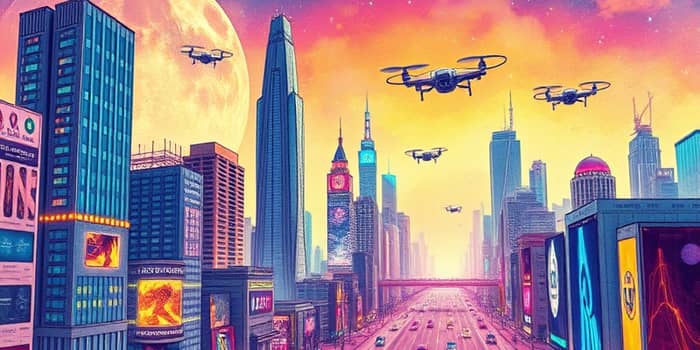
In today’s rapidly evolving world, innovation moves at an unprecedented pace. From the rise of artificial intelligence to the power of additive manufacturing, a wave of breakthroughs is transforming every sector.
These groundbreaking advancements are not merely incremental improvements; they are fundamentally altering the way businesses operate, how consumers interact with products, and the very structure of global markets.
Definition and Core Concepts
By definition, a disruptive technology is an innovation that fundamentally alters how consumers and organizations operate. It often begins by serving a small, overlooked niche before scaling to mainstream dominance through superior performance or cost advantages.
Such innovations can be categorized as either low-end, providing simpler and more affordable alternatives, or new-market, creating entirely novel ecosystems and engaging previously untapped customer segments.
Major Disruptive Technologies in 2025
Several technologies have reached critical mass by 2025, each boasting significant market projections and real-world applications.
- Artificial Intelligence (AI) and Machine Learning: Projected to generate up to $15.7 trillion in global revenue by 2030, AI is already delivering $920 billion in annual net benefits to S&P 500 companies. From advanced analytics and chatbots to fraud detection and drug discovery, this domain underpins the so-called “Intelligence Age.”
- 3D Printing (Additive Manufacturing): With a market value expected to reach $101.74 billion by 2032, 3D printing is revolutionizing prototyping, healthcare with custom implants, and even construction of eco-friendly structures.
- Cybersecurity and Quantum Cryptography: As cyber threats intensify, budgets for cybersecurity software are set to grow by 9.8% in 2025. Quantum cryptography promises virtually unbreakable encryption, while AI-driven threat detection fortifies defenses.
- Blockchain and Decentralized Finance: Tokenization of real-world assets could unlock a $2–$16 trillion opportunity by 2030, transforming payments, supply chains, and financial inclusion through transparent ledgers and smart contracts.
- Edge Computing and IoT: With investments surpassing $6 billion in 2024, edge computing reduces latency by processing data close to its source. Combined with over 16.6 billion connected devices, smart cities and autonomous vehicles gain unprecedented real-time responsiveness.
- Virtual Reality (VR) and Augmented Reality (AR): Enterprise applications in training, design collaboration, and immersive experiences continue to expand, driven by headsets like Microsoft HoloLens and enterprise software platforms.
- Quantum Computing: Tackling problems beyond classical capabilities, quantum computers are poised to accelerate breakthroughs in logistics optimization, financial modeling, and complex pharmaceutical research.
- 5G and Enhanced Connectivity: Ultra-low latency networks enable seamless streaming, real-time remote control of machinery, and large-scale IoT ecosystems vital for smart infrastructure.
- Automation, Robotics, and Autonomous Systems: From factory floors to delivery drones and self-driving vehicles, robotics is reshaping supply chains, mobility, and service industries with unprecedented efficiency.
- Renewable Energy and Greentech: The addition of 582 GW of renewable power in 2024, predominantly solar, underscores the shift toward electrification and sustainable infrastructure across industries.
- Work-From-Home and As-a-Service Revolution: Cloud computing, virtual collaboration, and everything-as-a-service models are redefining workplace dynamics, making remote and hybrid work a permanent fixture.
- Healthtech and Biotechnologies: Telemedicine, genomics-driven personalized medicine, wearable sensors, and synthetic biology are driving patient-centric healthcare models and accelerating drug development.
Sector-Specific Disruption Examples
Across diverse industries, disruptive technologies have already rewritten the playbook. Examining key sectors reveals the depth of transformation.
Industry and Societal Impact
The ripple effects of these technologies extend far beyond boardrooms. They are driving a profound transformation of the global value chain, enabling predictive maintenance through digital twins and optimizing logistics with real-time data.
Platformization has emerged as a defining trend, with software-as-a-service, platform-as-a-service, and infrastructure-as-a-service models lowering barriers to entry and offering flexible scalability to startups and enterprises alike.
On the workforce front, routine tasks are increasingly automated, prompting a shift toward roles demanding higher digital literacy and creative problem-solving.
These changes raise complex ethical and regulatory questions, from AI bias and data privacy to the governance of autonomous systems, highlighting the need for robust global frameworks.
Trends and Future Directions
Looking ahead, several emergent patterns signal where disruption is headed.
- Technology Convergence: The most powerful innovations will emerge where AI, IoT, blockchain, and quantum computing intersect, forging new applications with compounded impact.
- Sustainability and Green Tech: Climate-driven solutions like energy storage, carbon capture, and electrified transport will redefine industrial priorities and investment flows.
- People-Centric Productivity: As hybrid work models prevail, tools that enhance collaboration, wellbeing, and user experience will rise in prominence.
- Sectoral Hotspots: Healthtech continuums, regtech for compliance, blue-collar software, and autonomous mobility-on-demand are poised for explosive growth between 2025 and 2030.
Conclusion
Disruptive technologies are not a distant future—they are here, reshaping industries in real time. Organizations that embrace these innovations will unlock new revenue streams, drive efficiency, and create value for customers.
Success demands a balanced approach: investing in cutting-edge capabilities while fostering ethical standards, workforce upskilling, and collaborative governance.
By staying informed, agile, and purpose-driven, businesses and individuals alike can harness the full potential of disruption to build a more innovative, inclusive, and sustainable future.