
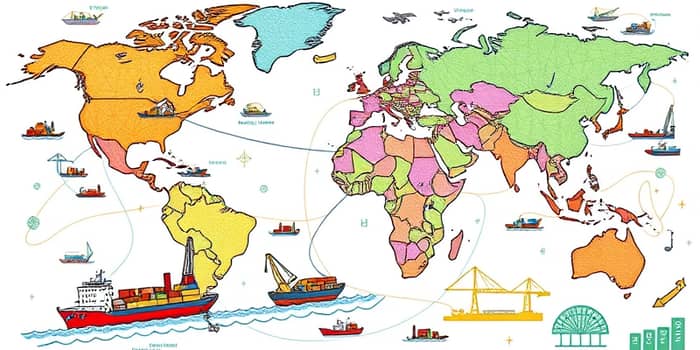
In an era of unprecedented change, the pathways that bind our global economy are undergoing a radical transformation. From shifting trade corridors to emerging digital tools, businesses and governments alike are navigating a landscape defined by uncertainty and innovation. This article explores the forces at play and offers practical insights into thriving amid this new face of globalization.
While merchandise trade projected to slow, the sectors driving expansion are evolving rapidly. Services such as freight, logistics, and e-commerce now underlie much of modern commerce, reflecting changing consumer habits and business priorities.
These forces underscore the need for embracing digital transformation across operations and forging partnerships that align with new geopolitical realities.
Data underscores the magnitude of these shifts. Baseline scenarios anticipate global trade value rising by $12 trillion, reaching $45 trillion by 2035, a 35% increase. Annual growth forecasts paint a mixed picture:
Yet, in 2025, roughly $2.7 trillion in goods faced trade restrictions, and 50–60% of commerce still funnels through critical chokepoints like the Suez and Panama Canals. As capacity strains intensify, stakeholders must innovate to maintain momentum.
Geopolitical realignments and new infrastructure investments are redrawing the map of global logistics. The following table summarizes the most significant geographic shifts and their potential impacts:
This table highlights the strategic shifts that stakeholders must consider when mapping future investments and operations.
Certain industries are at the forefront of rerouting global flows. Electronics, textiles, and machinery have been among the most agile, quickly adapting to alternative corridors. Meanwhile, energy, materials, and metals from Latin America and the Middle East are diversifying destinations, trading with advanced economies in ever-greater volume.
In agriculture, the development of Pacific corridors in Peru is channeling fresh produce directly into Asian and ASEAN markets, reducing transit times and spoilage. These examples underscore the power of targeted infrastructure to unlock new commercial opportunities.
Persistent congestion at major waterways, combined with climate-exacerbated disruptions in riverine arteries like the Rhine, has prompted companies to explore diverse logistics options. The surge in air freight demand and rising rates reflect the premium placed on reliability amid uncertain ocean schedules.
At the same time, governments are tightening customs procedures, with stricter border controls and documentation requirements. Adapting to these changes means deploying technologies for real-time risk analysis systems and automated clearances, ensuring that goods move swiftly despite regulatory hurdles.
From the Sahel to the South China Sea, geopolitical tensions threaten to sever vital connections. Instability in West and Central Africa jeopardizes overland and port operations, while escalating China–Taiwan strains push companies to reroute away from high-risk zones.
European energy security also remains in flux. Having cut Russian gas imports from 45% to 19% since 2024, the EU aims to eliminate dependence by 2027, reshaping trade patterns for natural resources and alternative suppliers.
Climate risk is no longer peripheral; extreme weather events threaten key chokepoints and inland routes alike. Against this backdrop, nearly 90% of new infrastructure financing since 2024 has carried a climate or ESG mandate, fostering investment in trade infrastructure projects with climate mandates.
By 2030, blended and programmatic finance models are expected to underpin corridors in Lobito, ASEAN, and the India–Middle East–Europe route, balancing risk and return while promoting resilience.
Adaptation is no longer optional. Companies that succeed will embrace route diversification and nearshoring efforts, bolster warehousing capacity, and partner with advanced logistics providers. Embracing digital transformation through AI-driven planning, blockchain for transparent documentation, and automated freight forwarding is critical.
These steps not only mitigate risk but also position organizations to capitalize on shifting trade dynamics.
Looking ahead to 2035, up to one-third of global trade could migrate between corridors as geopolitical landscapes evolve. Emerging economy corridors, particularly those linking China with ASEAN and the Middle East, are poised for robust expansion, while some advanced economy routes may contract.
For businesses and policymakers alike, the mandate is clear: foster agility, invest in technology, and cultivate partnerships that align with both commercial objectives and geopolitical realities. By doing so, stakeholders can transform challenges into avenues for growth and innovation.
Globalization’s new face is complex, but it offers unprecedented opportunities for those prepared to navigate its currents. Armed with strategic foresight and a commitment to resilience, we can chart a course toward a more connected and dynamic world economy.
References